





Artist Stanislava Pinchuk positions marble not only as an aesthetic material but also as a carrier of memory. Ukrainian artist Stanislava Pinchuk’s highly acclaimed installation series, The Wine Dark Sea, was first exhibited three years ago in Australia, yet it continues to carry a powerful message that remains relevant today: Marble is not merely a natural stone; it is also a silent witness to human history.
The work, exhibited in Art Basel Hong Kong’s “Encounters” section, offers a critical look at Australia’s controversial refugee policies. Pinchuk developed this work based on the “Nauru Files,” which were leaked to the press in 2016 and documented human rights violations in refugee camps in Manus and Nauru. By carving pages of reports on violence and neglect into marble slabs, the artist aims to take these documents out of digital obscurity and transform them into a permanent, physical monument.
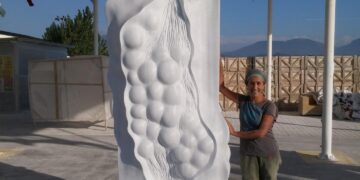
The artist explains his choice of marble as follows: “Marble is both beautiful and has historical weight. It is also a material that offers no second chances, much like the fate of a refugee.” Having developed a deep connection to stonework while apprenticing with a gravestone carver during the pandemic, Pinchuk sees marble not only as a tool but also as a narrator.
The Wine Dark Sea installation juxtaposes passages from Homer’s Odyssey with statements from the Nauru Files, creating a kind of narrative reversal. Through this narrative game, Pinchuk questions why migration is celebrated as a heroic tale in Western literature while real-life migrants are marginalized. “You think you’re reading about Odysseus, but you’re actually reading a message sent from a refugee camp,” says the artist.
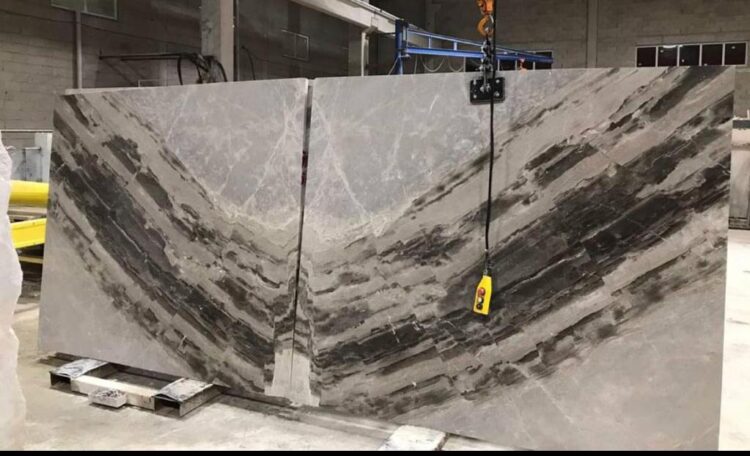
One of the most striking aspects of the installation is the conscious choice of stone. Veined marble, reminiscent of waves crashing against rocks, represents both the sea and the land, the two poles of migration. For Pinchuk, who loves working with layered textures, stone is not just aesthetic; it is a surface where the earth, humanity, and history intertwine.
The artist’s project highlights the power of stone as both a monument and a witness. Today, it reminds us that marble can be used not only in architecture or design, but also as a carrier of social memory.



 +90 532 585 51 95
 +90 532 585 51 95