


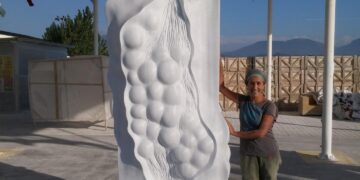


A journey from the history-redolent streets of Florence to the mountains of Carrara steeped in marble… Artist Andrea Berni brings the invisible bond between nature and humanity into his works. He approaches marble not merely as a material, but as a presence that bridges the past and the present, nature and humankind. In his sculptures, Berni explores emotions, social strata, and inner transformations, speaking to the contemporary viewer with a silent yet powerful artistic language.
Could you briefly introduce yourself to our readers?
My name is Andrea Berni and I’m an artist from Carrara, Italy. My studio is located in the heart of the city, where I’ve been pursuing my artistic research for many years.
I was born in Florence, but my passion for sculpture and the expressive power of materials brought me here, among the mountains where marble has shaped not only the landscape but also centuries of art and architecture. When I experience these mountains, the forests, and observe the beauty of the sea meeting the sky, a certainty grows within me, everything is connected. People, animals, plants, earth, air; every element is essential for the survival of the others.
This interdependence is a recurring theme in my work: trying to see the nuances that unite us is a constant pursuit. Art, for me, is precisely this; a means to explore and communicate emotions, social reflections, and the delicate balance between human beings and nature.
I’m deeply fascinated by human relationships and the complexity of individual identities, both in their uniqueness and in their relationship with the world. I enjoy questioning myself about sensations that are difficult to explain, and this seeking to understand often opens my eyes, helping me better comprehend the people and world around me. In my studio, I spend hours dialoguing with materials, sometimes in silence, other times with loud music and hands covered in dust.
It’s there that I feel I’m in the right place, when time expands and every gesture, even the smallest, contributes to giving shape to something that didn’t exist before.
How did your journey as a sculptor begin? When and how did you decide to pursue art?
I’m convinced that growing up in Florence gave a tremendous boost to the creativity I’ve always had inside. It’s a city so rich with works by the great Renaissance masters that it inevitably influenced my way of thinking about and experiencing art, even at a stylistic level.
But beyond the city, the real spark was my passion for the creative act itself. The satisfaction I’ve always felt in creating something is a fundamental part of who I am. Since childhood, I’ve felt the need to build, invent, and give form to something from nothing, and I realized that through this language I could express and communicate emotions and thoughts that I otherwise would never have known how to articulate.
When I was 14, I visited Florence’s beautiful art school, and finding myself in the plaster cast gallery, surrounded by casts of works by the great Renaissance masters, close enough to touch and study them, removed all doubt from my mind. It was in that moment that I knew with certainty this was the path I wanted to follow.
Your works often emphasize emotions, feelings, and the inner world. Is your art a form of expression, a search, or a process of transformation for you?
For me, art is both expression and research, and it’s certainly a process that profoundly influences my personal transformation and development as an artist. But it’s also much more. All these aspects are part of my way of experiencing art.
Often, my intent isn’t just to evolve my artistic vision, refine my style, or perfect my technique, but also to cultivate growth in those who come into contact with my work. If I can plant a small seed in the thoughts of viewers, capable of generating reflection or inner change, then I feel I’ve truly communicated something.
Over time, I’ve understood that many of the questions and reflections I express in my works resonate with others as well. And when someone manages to grasp them, a profound connection is created, as if our thoughts recognize each other, even without direct acquaintance.
It’s a type of encounter that goes beyond words, beyond space and time. And perhaps this is, for me, the deepest meaning of art: creating an invisible, intimate bond that overcomes every barrier.
It’s the same emotion I feel before the works of artists I admire, even those who lived centuries ago. A contact that doesn’t come from physical knowledge, but from something deeper.
What would you say about the challenges and beauty of working with marble?
Marble is an important, extraordinary material, with unique characteristics and profound beauty. I primarily work with white Carrara marble, which possesses a unique delicacy. It’s an honor to work with something that carries such an ancient past, born from immense geological forces and worked for centuries. This is clearly perceptible when you observe and work with it; it demands time, patience, and calm, doesn’t forgive mistakes, and forces you to reflect. It has a strong, deep soul, and when it meets the right hand, whether for an architectural or sculptural project, the result emanates a fascinating and almost mystical presence.
When I begin a marble sculpture, its presence makes itself felt. Its weight forces you to immediately dedicate much attention to it; it must be observed, caressed, and studied from the start to avoid future surprises. In short, it wants to become the protagonist from the beginning. But when I work with it and it’s struck by a ray of sunlight, its brilliance has incredible power. It seems impossible to be able to work a piece of mountain like this: it truly carries something unreal. Sometimes it’s white as snow, sometimes it resembles ice. What you obtain is so powerful that it makes you forget all the difficulties just overcome.
Unlike other materials, marble wants its time to be worked. It has a slow rhythm, less frantic if we compare it to everyday life. It forces you to think, and occasionally it captivates you and makes you lose yourself among its white crystals.
One thing that drives me crazy is also the variety in which it’s found throughout the world. Every block is different, every type, color, veining has its own character, and this makes every sculpture that emerges unrepeatable. It’s a type of material with virtually infinite expressive possibilities.
What essentially overwhelms me and makes me love it is that, fundamentally, marble is a part of the earth, and working with it, for me, means entering into a relationship with nature and dialoguing with it.
What do you pay attention to when choosing the marble you use in your sculptures? Which type of marble do you prefer and why?
The marbles I prefer are those that manage to create balance with the work I want to create. Each marble has its peculiarities and unique presence, which must harmonize perfectly with the sculpture I intend to realize. Usually, I like blocks with few veins and a rather homogeneous composition.
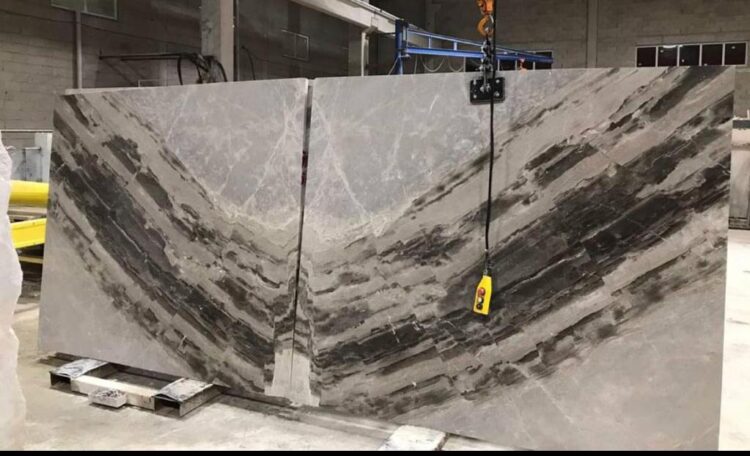
I appreciate when they’re slightly transparent, for that delicate and soft aura, almost like velvet. However, I’m also attracted to those less deep ones that highlight the design and textures of the tools I use, creating intense and profound contrasts. Every marble and stone has its beauty, and choosing can be difficult.
Sometimes I find myself traveling among the fantasies of arabescato marble, fascinated by its origin and captivated by its characteristics and the challenges it poses. In the end, everything comes down to finding the right coexistence, that singular balance that accompanies the artist’s idea and approach. I’m a reflective and calm person, and what I try to communicate is like a small whisper. Therefore, balancing with a delicate but serious and intense marble for what I do is often the best choice.
Which projects or goals in your artistic journey excite you the most? What are your plans for the near future?
At this moment, what excites me most is pursuing authentic artistic research based on my observations of the world around me. I’m working on projects where I try to find the right nuance and connection between humans and nature, playing on that fine line that ideally separates us.
I want to explore the emotions we carry within and experience daily, but often consider secondary or take for granted, when in reality they are what make us human and precious. I like to relate all this to the social structures in which we live. I’m attracted to projects that allow me to experiment and deepen the bond between form, material, and emotional content.
One of my goals will certainly be to create a communicative environment with my works, to the point where the environment itself becomes a work, an experience, and a memory; a “seed.” I’d like to create spaces capable of establishing a silent dialogue with those who observe them. In the near future, I wish to work on installations that aren’t just objects to contemplate but experiences to live, capable of evoking sensations, memory, and connection. Immersive artworks in which those who experience them can have a profound dialogue with my message and with themselves. Naturally, I’m interested in continuing to create unique pieces, but also in experimenting with communication through new technologies and languages, especially sustainable ones with strong expressive qualities, as I’m already doing with marble and other natural materials.
What advice would you give to young designers, aspiring sculptors, or those just starting to work with natural stone?
My advice is to always work with passion and curiosity. Never stop challenging yourselves, because that’s precisely how you rediscover the true pleasure in studying the techniques and materials that allow us to express ourselves. Don’t let difficulties discourage you; instead, try to see them as opportunities for growth and challenges to face with determination. Only in this way can we build our true selves.
Art is full of unforeseen events and uncertainties, difficult moments and instances of pure joy. Sometimes it may seem like an insurmountable mountain, but looking back, you realize it was truly worth it. If our path is guided by sincerity, we’ll have no regrets.
I believe that everything we do, both artistically and in craftsmanship, contributes to forming a true expressive alphabet within us. The more “words,” experiences, and solutions we add, the more we’ll be able to create works that not only communicate authentically but also respect the world around us and invite reflection.
Working with natural stone, as with any other material, requires dedication and patience, but in the end it allows us to create something profound, which goes beyond the object itself and, who knows, might even remain in history.


 +90 532 585 51 95
 +90 532 585 51 95