






Founded in 2010 by Chahid Kairouz and now continuing as a multidisciplinary team with his siblings, CKA Studio has completed over 800 projects across Australia with its Melbourne-based work. Integrating architecture, interior design, and urban planning, the studio combines functionality with aesthetics in projects of all scales, placing natural stone at the heart of its designs. For them, stone is not just a material; it is an element that adds uniqueness, permanence, and tactility to a space, telling a new story in every project. Working across a wide range of projects, from residential to multi-residential, educational to commercial spaces, CKA Studio continues to create meaningful and characterful spaces that withstand the test of time through the power of natural stone.
What is the core approach that sets CKA Studio apart from other architectural firms?
At CKA Studio, our approach is rooted in creating spaces that are thoughtful, functional, and built to endure. What sets us apart is our commitment to clarity of purpose—balancing creativity with practicality, and design vision with long-term value.
By integrating architecture, planning, and interior design under one roof, we offer a truly collaborative and streamlined service. This multidisciplinary model allows us to navigate complexity with ease and deliver cohesive, well-resolved outcomes. Every project begins with a conversation; we take the time to understand our clients’ vision, constraints, and goals, then draw on the right mix of skills and perspectives to guide the project forward with clarity and confidence.
From feasibility and planning through to detailing and delivery, we manage each phase with care, creativity, and transparent communication ensuring not only a seamless process, but a result that stands the test of time.
As a team with over 800 completed projects, what still excites or inspires you the most?
Even after delivering over 800 projects across Victoria and Australia, what continues to excite and inspire us is the opportunity to shape environments that genuinely improve the way people live, work and connect. Every project brings a unique set of challenges, contexts and possibilities—and it’s this diversity that keeps our practice dynamic and our curiosity alive.
At CKA Studio, we’re driven by the belief that great design must respond to people, place and purpose. Whether we’re working on a bespoke home, a school in a regional community, or a complex multi-residential development in the city, we are inspired by the potential to create spaces that are not only beautiful, but functional, enduring and socially responsible.
What also motivates us is the strength of our multidisciplinary team. With expertise spanning architecture, interior design, planning and project management, we thrive on collaboration—drawing on a broad range of perspectives to create site-responsive solutions that are both creative and grounded in real-world functionality.
As our studio grows—with locations in Thornbury, Glen Iris and Geelong—we remain excited by the evolving needs of our clients and communities, and the chance to keep learning through every brief. Design is never static, and it’s this continuous evolution—shaped by new materials, changing regulations, environmental responsibility, and diverse client visions—that fuels our passion for what we do.
How has the rebrand to CKA Studio influenced your approach to client relationships, internal culture, or design thinking? Has it opened new avenues for innovation or collaboration?
The rebrand to CKA Studio marks an exciting evolution in our practice—one that reflects not only who we are today, but who we continue to become. As our studio has grown in scale, capability and reach, we found that our previous branding no longer fully captured the breadth of our expertise or the collaborative, multidisciplinary nature of our work. CKA Studio represents a more focused and contemporary expression of our identity—one that honours our roots while embracing our future.
Internally, the rebrand has energised our team and reaffirmed our shared values. As a family-founded practice, the notion of family is deeply embedded in our studio culture. We’ve always strived to foster a safe, supportive environment where every voice is valued and every team member—from early career designers to senior leaders—feels empowered to contribute. The rebrand has amplified this spirit, instilling a renewed sense of pride and ownership across the studio.
For our clients, the transition to CKA Studio signals our continued commitment to clarity, creativity and care. It reinforces our integrated approach, bringing together all disciplines of the studio including architecture, interiors, planning and project management, to deliver seamless, end-to-end solutions that are both visionary and grounded in real-world functionality. The response from our clients has been overwhelmingly positive, with the new brand opening fresh opportunities for dialogue, engagement and deeper collaboration.
Ultimately, the rebrand has given us space to grow, to think more ambitiously, and to continue striving for better in everything we do. While collaboration has always been a cornerstone of our practice, the clarity and momentum of the new identity have allowed us to explore new methods, tools and partnerships with greater confidence and purpose.
You mention that you’re not afraid to take on challenging projects. Could you share one that was particularly difficult but also a source of pride?
One of our most challenging and rewarding projects was Kirra Gardens—a medium-density residential development comprising 44 apartments in Camberwell. The site posed multiple complexities: a sloping topography, proximity to a busy arterial road, and integration into a low-rise, heritage-influenced neighbourhood. We worked closely with local council and state planning policy to navigate these constraints, adopting a U-shaped layout that maximised light, ventilation, and communal space while reducing visual bulk and respecting the surrounding streetscape. The result is a carefully considered response that balances density with liveability and community benefit.
Kirra Gardens was also a highly bespoke development, with many residences tailored to suit specific end-user needs. The site’s non-typical grid and building spread—effectively three structures—required detailed planning, staging, and coordination across multiple work fronts. Despite its scale and complexity, the project delivered sustainable, high-quality homes for a diverse mix of residents, setting a new benchmark for thoughtful, future-ready apartment living in Melbourne’s inner suburbs.
How important are texture and material selection in your design philosophy? What role does natural stone play in your projects?
Texture and tactility is everything. It’s what draws you in- it’s visceral, emotional and activates senses that can often be forgotten in design.
Materiality, is at the core of how we design, never an afterthought; it’s the backbone of creating holistic spaces. Spaces that breathe and age.
Natural stone, in particular, plays a grounding role in our work. It brings authenticity and a sense of permanence that few other materials can offer.
It has a quiet power in its imperfections- no two pieces are ever the same, and that individuality is something we deeply value.
In our projects, it often becomes the emotional anchor: bringing bold expression, vibrance, luxury and unpredictability to any space.
Its beauty can truly be undeniable, but its also about its substance.
How do you approach the use of natural stone and marble in your work? In your opinion, how do these materials contribute to your architectural language?
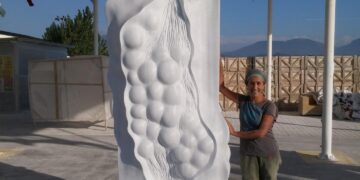
We approach stone with Intention. It’s not used as decoration – it’s there to carry weight, literally and metaphorically. It has a story to tell but also a purpose. But its in those moments when it forces you to slow down and take notice that I enjoy most.
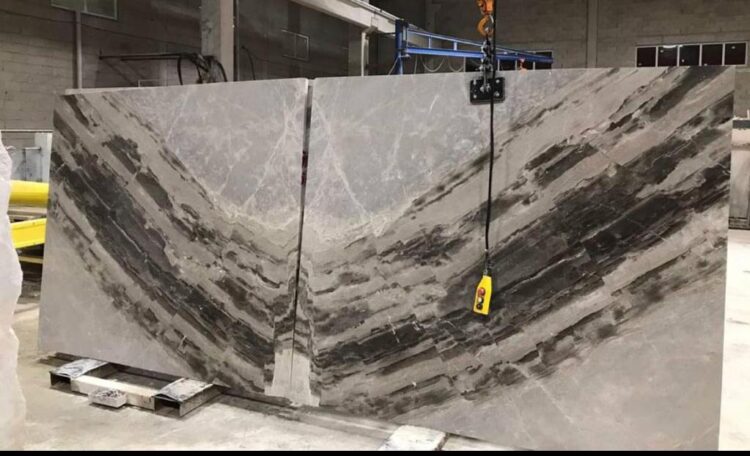
In terms of architectural language, whether its routered, carved, split faced, a blade of veined marble, polished in all its glory; it introduces a certain clarity and confidence to a space. There’s a tension between delicacy and permanence that feels exciting.
Over time, it softens and settles in -it becomes part of the architecture’s fabric and memory within a space.
When selecting marble, what criteria do you prioritize? Do you have a hierarchy among elements such as color, veining, and surface quality?
It’s more instinct than formula. We tend to be drawn to slabs with strong character- colour interplay, pattern shifts, a sense of movement. But it always comes down to how the stone sits within the broader composition and design context and needs unique to each space. Sometimes the quietest slab is the most powerful.
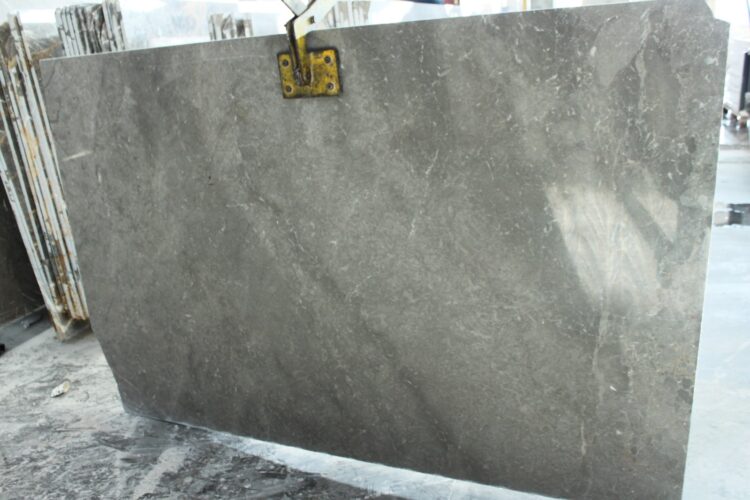
Surface finish plays a huge role too -honed or leathered stones feel more grounded and allow light to interact differently. It also is a major consideration to its functionality and useability. Colour is mood setting- but it has to support the narrative of an entire space.
The hierarchy shifts depending on the story we’re telling. Ultimately its more a conversation among those elements- when they’re in harmony, you feel it.
What new fields or project types are you planning to focus on in the near future?
We’re focusing more on projects that value depth and experience over scale—places where atmosphere and detail really matter. Hospitality, boutique developments, elevated residential are a few that resonate. We’re also exploring how to integrate natural stone in more expressive ways—thinking sculpturally, not just architecturally. There’s a beauty in pushing material tradition forward without losing its soul.




 +90 532 585 51 95
 +90 532 585 51 95