


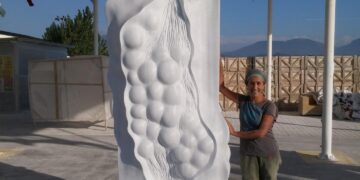


Nurgül Gökçen, one of the younger generation of artists who brings together the memory of materials, the traces of the body, and the spirit of space, expands her dialogue with stone across different disciplines. For her, sculpture is not merely a search for form, but also a connection with time, belonging, and transformation. Beginning her artistic journey in Burdur, Gökçen has transformed it into an interdisciplinary practice through sculpture and now continues her work in Istanbul. Her academic education, which started at Hacettepe University and continued at Mimar Sinan Fine Arts University, was further enriched by international experiences in Carrara and Turin. Approaching marble not just as a material but as a bearer of memory, space, and the body, the artist defines sculpture as a bridge between the visible and the invisible, as well as a space for inner exploration.
Could you briefly introduce yourself?
Hello, my name is Nurgül Gökçen, and I was born in Burdur in 1997. I create interdisciplinary works based on sculpture. I completed my undergraduate studies at Hacettepe University and my master’s degree at Mimar Sinan Fine Arts University. I studied in Carrara and Turin through the Erasmus program. I continue my work in Istanbul.
How did your journey with art begin? What inspired you to become a sculptor?
I have been drawing since my childhood. My relationship with colors, lines, and surfaces evolved over time from being just a game or hobby into an internal language. This inclination led me to art school. Although I focused mainly on painting throughout my high school education, I gained experience in direct contact with materials and form through the sculpture classes included in the curriculum. Life gradually steered me towards sculpture.
What drives me to create is the multi-layered nature of this field. This simultaneous relationship established with the body, space, time, belonging, and material forms the basis of my creative practice, my way of perceiving the world, and my language of self-expression. For me, sculpture is not just an object; it is a carrier of memory, a silent witness, a transitional space. That is why, in my opinion, sculpture is the most honest and resilient journey on which I can trace both the visible and the invisible.
What are the main themes that emerge in your art?
John Berger’s statement, “I don’t know, because everything happens in a place where words don’t exist,” points to the realms of emotion and thought that lie beyond the limits of language. These inexpressible voids allow new dialogues to sprout in places language cannot reach; thus, the work constructs its own fictional space. In this context, artistic production becomes an experience based on improvisational actions within the process, rather than a structure aiming for perfection.
The relationship established with the material is not merely a technical process; it is a form of contact, listening, and belonging. Interventions take shape within a specific time frame, through both conscious and unconscious influences. Therefore, the result is the bearer of an unrepeatable situation. Each work is a record of the moment, the body, the space, and the state of mind in which it was produced.
What can you tell us about the challenges and beauties of working with marble?
Marble is a material with a powerful historical and symbolic weight. As a carrier that has mediated many cultural representations from antiquity to the present day, working with it is not just a technical matter; it also means touching this multi-layeredness.
Working with marble at this stage of my life both excites me and invites me on an inner journey. This process is like a state of meditation; a profound experience. This relationship I have with marble began
in 2018, when I first went to Carrara. The first stone sculpture I made there opened a new door, both to the material and to myself.
This journey is not merely a formal production process; it has also become a way of establishing an inner connection that develops in parallel with the place I am in, the people around me, and the transformations I experience.
On the other hand, I continue my productions with different materials and techniques such as photography, video, plaster, and water, without being limited to stone.
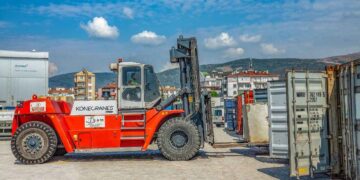
One of the most obvious difficulties when working with marble is its physical weight. The mass of marble complicates the production process not only technically, but also logistically and spatially. Moving and positioning the stone requires physical endurance, planning, and often external support mechanisms.
What do you look for when choosing marble for your sculptures? Do you have a preferred type of marble, and why?
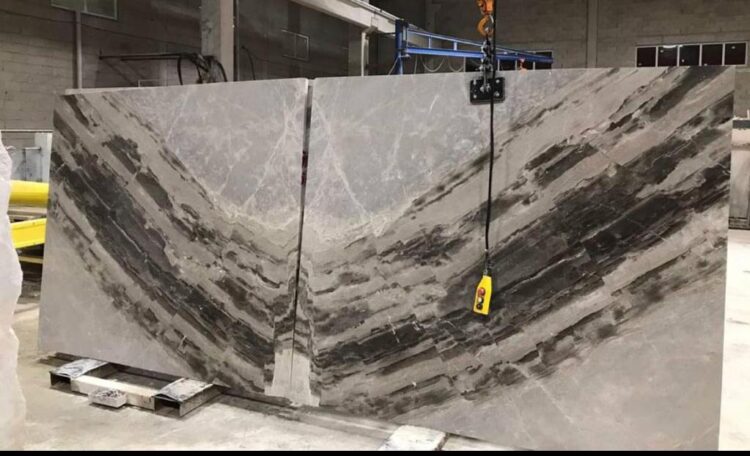
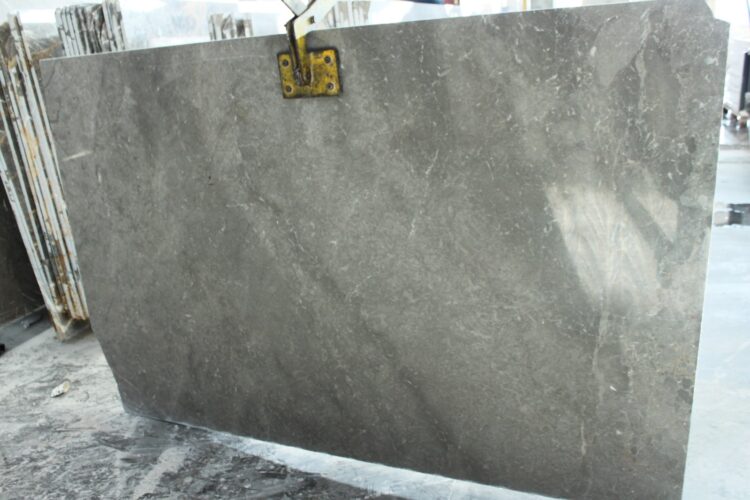
I generally prefer stones with amorphous forms; pieces that have been worn down over time, broken off naturally, bearing the traces of natural processes, appeal to me more. The randomness and worn-out appearance of these types of stones contribute to my production both formally and conceptually. Apart from that, I take care to choose stones that do not have distinct veins or have a more homogeneous structure in terms of color transitions.
In your opinion, when is a sculpture considered complete? How do you know when that moment has arrived?
It’s a constantly changing situation; I change, my creations change, needs change. The feeling of completion sometimes comes with a detail, sometimes it matures over time. That’s why the rhythm and duration of each work is different.


 +90 532 585 51 95
 +90 532 585 51 95