


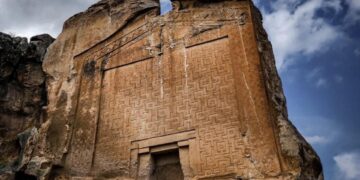
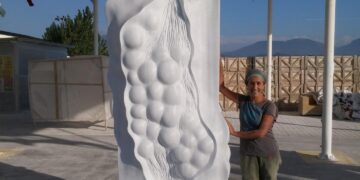


Working at the intersection of art, archaeology, and restoration, Prof. Dr. Hesam Mohtasham combines the knowledge of the past with a contemporary artistic language in his productions. Working with different materials such as stone, metal, wood and glass, Mohtasham, together with his wife Shiva Taghpoor under the SESEART umbrella, creates a wide range of works, from architectural art structures to sculptures. The artist, who combines his childhood passion for sculpture with academic knowledge, now brings an approach to each of his projects that carries both the nature of the material and the traces of time.
Could you briefly tell us about yourself and your career journey?
I am Prof. Dr. Hesam Mohtasham. I grew up immersed in art from my childhood years. I began creating my first sculptures and drawings at a young age. Over time, this passion merged with architecture, restoration, and archaeology. For me, art has no boundaries; size, material, or technique do not matter. I produce works in every material, from micro details to monumental structures, including stone, metal, wood, and glass.
Archaeology taught me the spirit of the past, architecture taught me balance, and restoration taught me patience. Today, my art is a holistic language born from the fusion of these three fields; knowledge, emotion, and matter come together in a single body.
I am also part of the SESEART company, where we see art not only as a means of expression but as a multifaceted form of production that touches all areas of life. SESEART produces a wide range of works, including sculptures, architectural art structures, interior and exterior art designs, artistic objects, furniture, lighting designs, and mixed-media artworks.
We carry out our projects together with my dear wife, Shiva Taghpoor. Her refined aesthetic vision and my technical-philosophical approach create a unique balance in every work. For us, each project is not just a design, but a life story.
How has your background in archaeology and restoration influenced your understanding of art?
Archaeology taught me that every stone, every trace has a soul. Restoration, on the other hand, taught me patience, the sanctity of detail, and respect for the past. Thanks to these two disciplines, I learned to perceive art not only on a formal level but also on a spiritual plane.
Reinterpreting the silent power of the past in the language of today is one of my deepest goals in my works.
How did your journey into sculpture begin?
Sculpture is a natural inner calling for me, stemming from childhood. Touching the material, feeling it, and conversing with it is an inner need. My education in architecture and restoration deepened this inclination. Sculpture became a point where science, emotion, and spirit converge for me—the purest form of dialogue between humanity and nature.
What themes or emotions guide you most in your artistic production process?
There are two fundamental forces in my art: power and silence. Power manifests itself in form and volume; silence is in the timeless energy within the stone. In each of my works, I try to balance these two opposites. Art, for me, is a journey between matter and spirit; from thought to stone, from stone to infinity.
Natural stone plays an important role in your works. Is there a particular reason you choose this material?
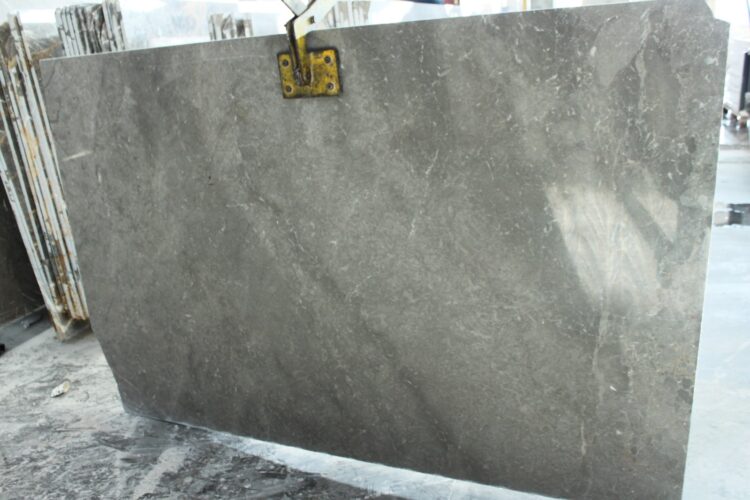
Stone is not just a material for me, it is a living entity. It forms deep within the earth for thousands of years and one day emerges to become a work of art. When I work with it, I engage in a dialogue with nature, history, and the human spirit. The power, patience, and truth of stone are found in no other material.
How do you select the types of marble you use? What are your priorities in terms of aesthetics, texture, or colour?
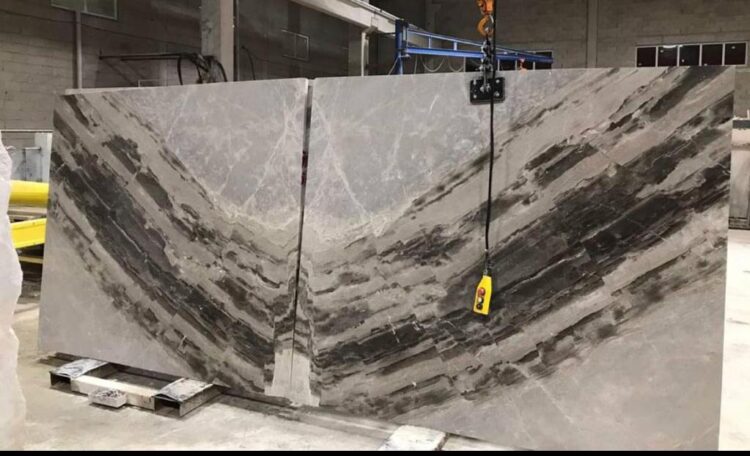
Each marble has its own unique voice, its own energy. I listen to what the stone tells me. Sometimes I seek the feeling of a warm tone, sometimes the inner strength of a deep, silent texture. My most important criterion is that the stone suits the spirit of the work. Beauty should serve meaning — not for decoration, but for expression.
What is the most challenging technical or emotional process for you when working with marble?
Working with marble is not merely a physical struggle; it is a matter of spiritual balance. You must understand the stone, capture its rhythm. Every strike has its time, its sound. Finding this balance is both the most difficult and the most fascinating moment. The stone guides you; the artist simply learns to listen to it.
What advice would you give to young people who want to advance in the field of art and restoration?
Never limit art. Neither material, age, nor gender are obstacles to art. True art is freedom itself.Whether you are 8 or 80 years old, any moment is the right time to start creating. Art has no age.Today, my 8-year-old son AHURA also started working with stone and is making his own little sculptures. This reminds me that art is not an inheritance, but a state of mind.My advice to young people: explore, experiment, make mistakes, take risks. Most importantly, live with your material — don’t just shape it, talk to it. Because stone whispers all its secrets to the artist who listens patiently.



 +90 532 585 51 95
 +90 532 585 51 95