






Designer and mechanical engineer Tina Bobbe is a name who has created her own unique world at the intersection of technology and craftsmanship. The exploration process, which began with generative artificial intelligence, quickly evolved into a design practice that produces sculptural and joyful objects. Bobbe’s approach aims to enhance the emotional impact of daily routines, centring on the durability, texture, and uniqueness of natural stone. By combining the stone’s millions of years of identity with the experimental language of modern design, she creates a personal story for each object. His work, ranging from espresso machines to coffee rituals, sustainable craftsmanship to AI-assisted form research, demonstrates how intuitive creativity and natural materials can coexist in the design of the future.
Could you introduce yourself? How did your design journey start?
My name is Tina Bobbe. I studied mechanical engineering and industrial design and worked in design research for a while. During my parental leave with my second child, I was craving time for creativity, which I didn’t have. That’s when I discovered generative AI tools that I could use right on my phone. I spent a lot of time exploring them, – creating, experimenting, and by that learning how to create. This was the inital start of my design journey.
How did the idea of combining artificial intelligence with craftsmanship come about?
With the generative AI tools, I just mentioned, I often generated images of objects – from surreal cars and sculptural interiors to bold, joyful coffee machines. Of course I had the urge of bringing some of it to life. And so I did.
What motivates you the most when transforming everyday objects into playful and sculptural pieces?
Every object surrounding us is designed. Of course, they must function well, be safe, and easy to use — but why shouldn’t they also bring us joy? I believe that objects can emotionally enrich our daily routines. Coffee machines, especially, carry so much meaning. Crafting the first cup of coffee in the morning is a small but important ritual for many people. The design of these machines should reflect individuality, meaning and joy — not just technical perfection.
Why did espresso machines become such a strong starting point for you?
The short answer: I love coffee. The longer answer: espresso machines tend to look quite technical and serious, with little visual variety on the market — unlike chairs or lighting, for example. I was missing a more playful, expressive, and sculptural approach to espresso machine design.
How did the design process of your first creations, “Pipe Frame” and “Pipe Frame Mini,” evolve?
The Pipe Frame idea began long before I thought of realizing it physically. With generative AI, I explored the question of how a ridiculously large espresso machine made of bold, colorful pipes might look. I loved the visual outcome so much that I decided to actually build it half a year later. That’s when the “frame” concept was born — not redesigning the coffee machine itself, but creating a structural frame that could house any coffee machine. The original Pipe Frame turned out to be too big for most kitchens, so I later created the smaller Pipe Frame Mini.
Do you use natural stone in your designs? If so, which types of stone do you prefer?
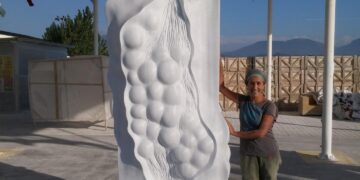
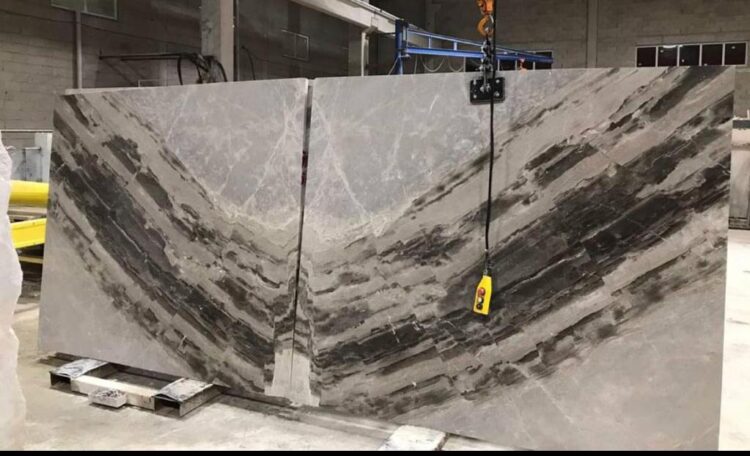
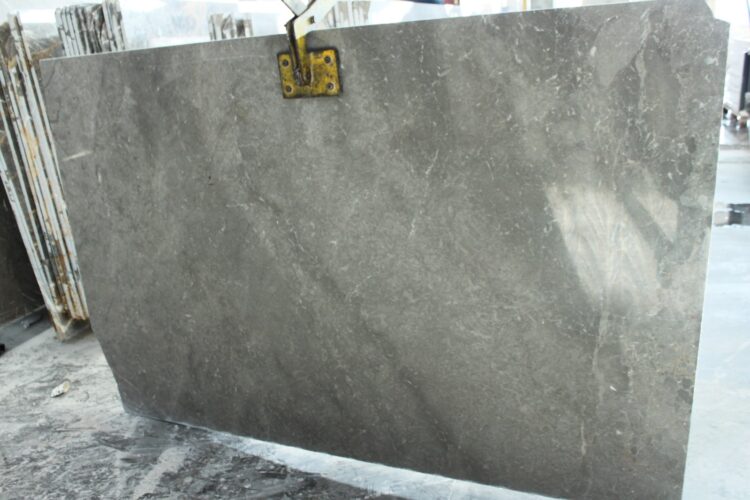
Yes — my Stone Drip Coffee Maker is primarily made of natural stone. I love stones that tell a story, that are imperfect and surprising. For me, Ivory Brown was one of those stones — expressive, full of depth, and beautifully unique in every piece.
How does the aesthetic and sculptural quality of natural stone align with your design philosophy?
Natural stone embodies timeless elegance and quiet strength. I’m drawn to the presence it brings to an object — the way it invites you to engage, to touch, and to explore its cool, tactile surface. Each piece of stone is inherently unique, giving every object its own personality and an identity that can never be repeated.
In your opinion, how does natural stone give a design object a unique identity?
Every stone slab is different — its veins, colors, and textures are formed over millions of years. That uniqueness makes every object truly one of a kind. When you work with stone, you collaborate with nature; you’re not just shaping a material, but embracing its unpredictability.
How do you see the relationship between artificial intelligence and natural materials in the future of design?
I don’t see artificial intelligence and natural materials as directly connected, but rather as two complementary parts of the design process. AI offers designers a new way of working — a tool to explore ideas, experiment with shapes, and discover new visual languages. These digital explorations can then take form in many different materials. In my own work, I enjoy translating these ideas into tangible objects using local craftsmanship and durable, honest materials that have character and permanence.
What can we expect from your upcoming projects
I’m continuing to explore the intersection of AI and object design. At some point, my projects will expand beyond coffee machines into other everyday objects, still with the same playful and sculptural spirit. The goal is to keep experimenting, to surprise myself and others with how technology and human creativity can merge into something truly personal and joyful.




 +90 532 585 51 95
 +90 532 585 51 95